Market Insights

Market Insights: 14. July 2026

AI-generated

Polarisation, premiumisation and platforms

Resilience and fragmentation redefine the SDA market

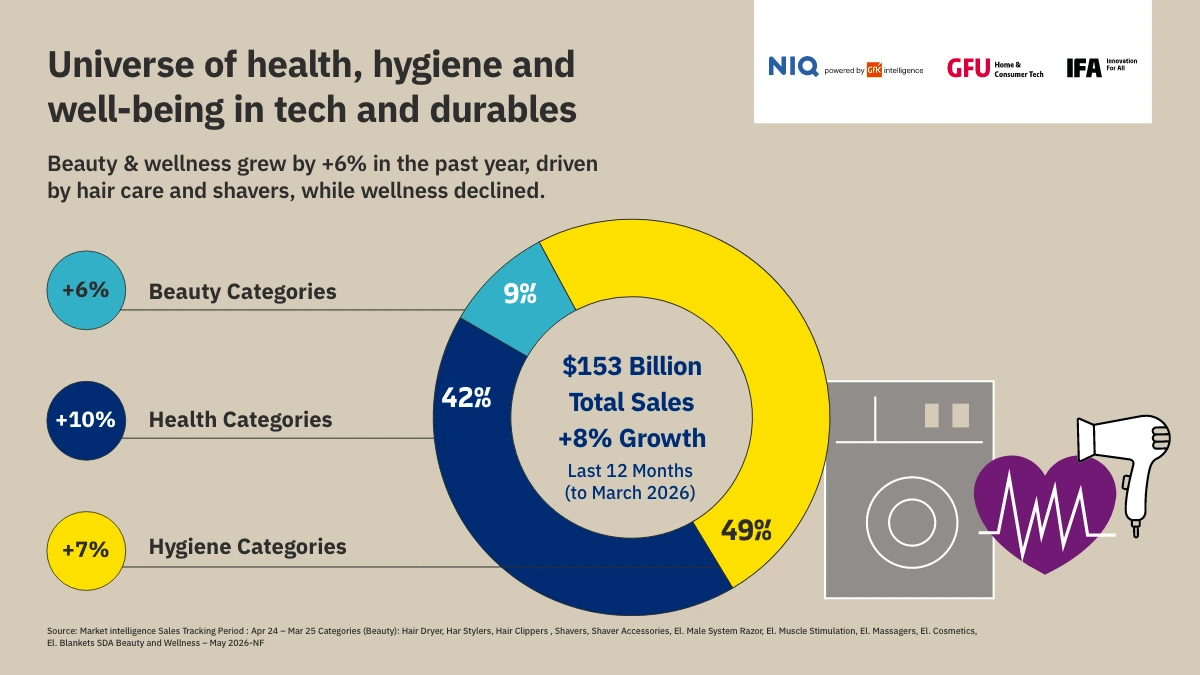
The Small Domestic Aplliances (SDA) beauty and wellness market is entering a structurally different growth phase—one driven less by macro expansion and more by strategic precision. Despite global GDP growth slowing to 3.1% in 2026, the category continues to outperform, delivering +6% value growth, signaling resilience even as discretionary spending tightens.

At the core of this performance is a deepening consumer divide. The NIQ Consumer Outlook 2025 study shows 24% of consumers plan to reduce beauty spend, while 20% intend to increase it, creating two parallel demand curves. This polarisation is structural, not cyclical—forcing manufacturers and retailers to design dual strategies that simultaneously capture premium trade-up and value-seeking behaviour.

Infographic about the beauty tech- and health tech sorted by categories until March 2026

Premiumisation drives category momentum

Category performance clearly reflects this bifurcation. Core grooming segments continue to scale, with hair stylers (+10%), shavers (+9%), and hair dryers (+5%) driving overall category growth. In contrast, discretionary wellness segments—particularly electrical cosmetics and muscle stimulation—are declining, with drop of up to -4% for electrical cosmetics, driven by saturation and increasing regulatory complexity.

Growth is increasingly value-led rather than volume-driven. Even as unit sales stabilize at nearly the same levels as the previous year (-0.5% decline), total category value continues to rise, underpinned by premiumisation. Consumers are purchasing fewer devices but opting for higher-spec, multi-functional products that combine performance, attachments, and design—reshaping price ladders and margin pools.

Nevin Francis Senior Director, Global Strategic Insights at NIQ

“Manufacturers and retailers need to build portfolios that ladder from entry to premium, while continuously refreshing innovation pipelines to avoid commoditisation—winning will come from aligning price, performance, and visibility across different consumer segments.”

Importantly, demand is being reshaped by younger consumers. Gen Z and Millennials account for ~57% of hair styling and dryer purchases, reflecting a generational shift toward style, self-expression, and performance-led products. In parallel, NIQ’s Consumer Life 2026 reveals that 41% of global consumers now view “looking good” as a core life value, an increase of +5pp over the past 2 years, underscoring a deeper cultural shift that directly fuels category demand.

Social commerce rewrites retail rules

The most profound transformation, however, is in channel dynamics. The purchase journey is now highly fragmented and digitally led: ~60% of discovery and sales occur online, while 53% of consumers have purchased beauty products through social platforms at least once. Social commerce—particularly TikTok—is collapsing the traditional funnel, with 68% of purchases driven by impulse and ~18% already transacting via TikTok Shop.

For retailers, this marks a fundamental shift. Competitive advantage is no longer defined by physical shelf space, but by algorithmic visibility and social validation. The rise of Key Opinion Consumers (KOCs), alongside AI-driven recommendation engines already influencing purchase decisions, means that discovery, influence, and transaction are now inseparable.

For manufacturers and retailers alike, the implications are clear: build dual portfolios, accelerate innovation cycles, and operate natively within digital and social ecosystems. In a fragmented market, winning will depend on precision execution—across consumers, categories, and platforms.

Carine Chardon

Carine Chardon Managing Director of GFU

“The steady level of sales shows how important this industry is to people’s daily lives. At the same time, rising consumer expectations are driving growth: buyers are consciously choosing high-quality, multifunctional appliances. Premiumization is not a short-term trend, but a key driver for the entire market.”

Your Direct Line to GFU

Press Contact & Media Relations Manager

Whether you are requesting an interview, looking for background information, or conducting research, the GFU press team is here to support you quickly and efficiently.

Portrait von Marie-Charlotte von Heyking, Pressesprecherin von GFU
Marie-Charlotte von Heyking marie.vonheyking@gfu.de

GFU Press Distribution List — Stay Informed Earlier, Report Better.

As an accredited media partner, you will receive GFU press releases, studies, and image materials on Home & Consumer Tech directly in your inbox — concise, relevant, and ready to use.