Market Insights

Market Insights: 17. June 2026

Bottleneck in the Memory Market

Why classic cycles in the computing market will be suspended in 2026

For decades, memory markets followed a familiar cycle: rising prices caused demand to fall, suppliers expanded their capacities, and equilibrium was restored. In 2026, this pattern no longer applies to PCs, components, and storage media. What is currently emerging is not a temporary bottleneck, but a structural redistribution of supply that will shape the industry far beyond this year.

At the center of this shift is a concentrated supplier base. Three suppliers together produce around 95% of the world’s Dynamic Random Access Memory (DRAM)β€”the classic main memory (RAM) used in computers and smartphonesβ€”and are therefore able to scale High Bandwidth Memory (HBM). As workloads in the field of artificial intelligence increase, wafer capacity is being redirected toward HBM and advanced DRAM, where margins are higher and utilization is secured through long-term contracts.

AI demand overrides market mechanics

Demand driven by AI differs fundamentally from traditional demand for consumer goods. AI systems are significantly more memory-intensive and require far more capacity per unit, while hyperscaler investments remain stable even as prices rise. Once supply capacities are tied up for AI infrastructure, they are effectively removed from the general market, thereby preventing the self-correction mechanisms that ensured price stability in the past.

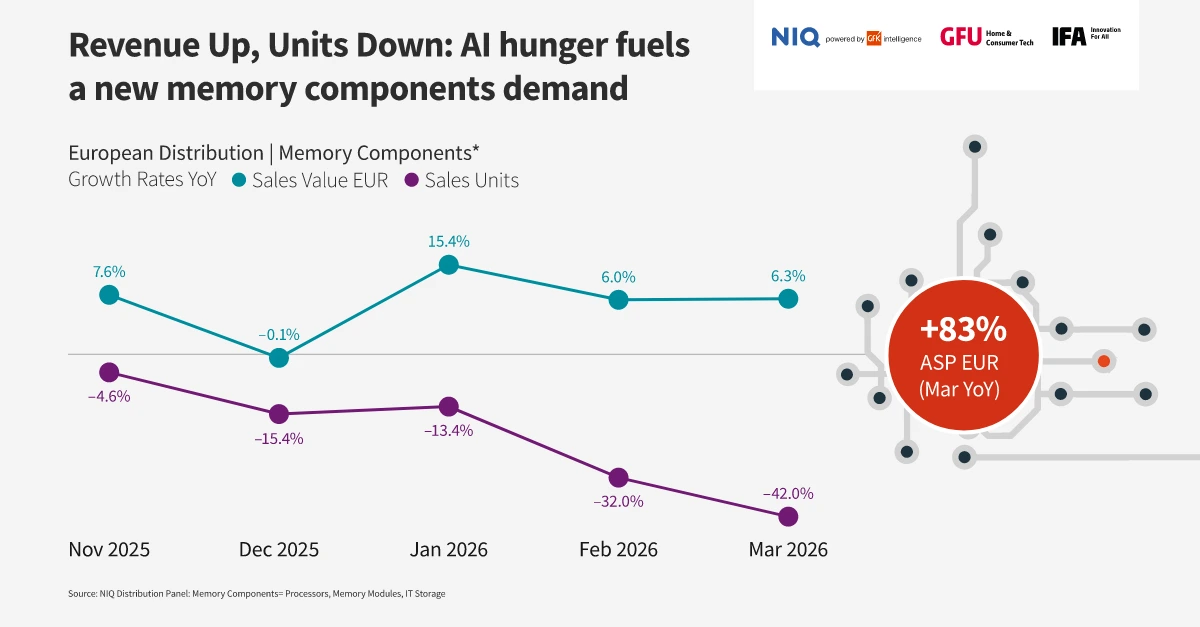
The key point here is that investment cannot resolve this imbalance in the short term. New production facilities require investments of 10 to 20 billion US dollars. And it takes years before they are operational and efficient. Even increased capital expenditure offers only limited relief, especially since new production capacities are already earmarked for advanced applications. The consequences are already being felt. In markets, particularly in Europe, sharp price increases for storage media can be observed alongside declining sales volumes, making it clear how quickly price-driven growth reaches its limits. The number of special offers is shrinking, product ranges are being streamlined, and volatility is increasing even before consumers experience actual shortages.

OEMs lose room to offset inflation

At the same time, rising minimum requirements are limiting OEMs’ flexibility. As 16 GB of RAM and 512 GB of storage increasingly become the standard for laptops, cost increases can no longer be easily offset through lower configurations. Competition is shifting toward tighter portfolio management and smarter configuration strategies, particularly in the mid-range segment under pressure.

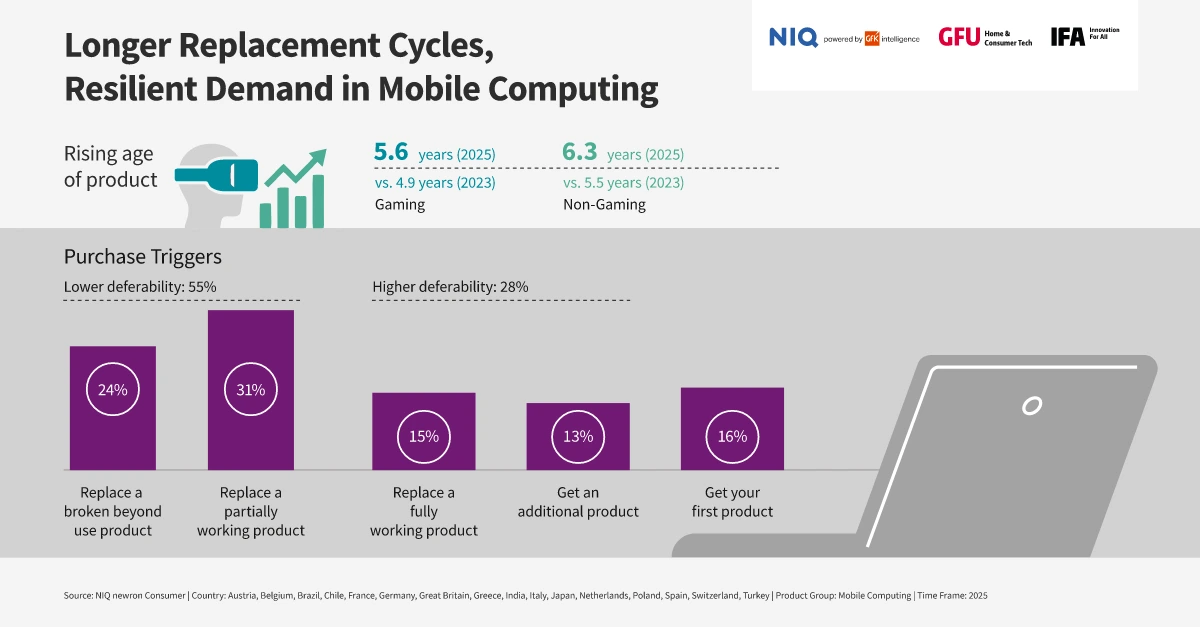
NIQ SIMA’s forecasts underscore that this is not a temporary phenomenon. In the baseline scenario, sales volumes in mobile computing (laptops) are expected to decline by around 10% in 2026, while prices rise by about 21%. Under more strained conditions, declines would amount to 14%, with price increases of nearly 30%. This points to a multi-year adjustment phase extending into 2027 and beyond. Consumers are adapting rather than withdrawing. Replacement cycles are lengthening and purchases are being postponedβ€”but demand remains tied to actual needs, increasing sensitivity to price and value.

β€œThis is not about memory becoming scarce,” says Namrata Gotarne, Global Strategic Insights Director at NielsenIQ. β€œIt is about how memory resources are allocated before the end-consumer and OEM markets can even compete for them. The effects are structural in nature and will influence decisions far beyond 2026.”

For market leaders, the consequence is clear: waiting for a return to previous cycles no longer makes sense. Success will depend on how they manage availability risks, find compromises, and prepare for sustained volatility.

Your Direct Line to GFU

Press Contact & Media Relations Manager

Whether you are requesting an interview, looking for background information, or conducting research, the GFU press team is here to support you quickly and efficiently.

Portrait von Marie-Charlotte von Heyking, Pressesprecherin von GFU
Marie-Charlotte von Heyking marie.vonheyking@gfu.de

GFU Press Distribution List β€” Stay Informed Earlier, Report Better.

As an accredited media partner, you will receive GFU press releases, studies, and image materials on Home & Consumer Tech directly in your inbox β€” concise, relevant, and ready to use.