Market Insights

Study: 4. November 2025

AI Meets Hardware – Familiarity and Benefits from the Consumer Perspective

Artificial intelligence has evolved in recent years from a promise for the future into an integral part of everyday life. Looking at the international average, two out of three consumers regularly use AI-powered applications – whether privately, professionally, or in their studies[1], with generative online tools in particular shaping the everyday lives of many consumers.
But what about the perception of AI-optimized hardware – that is, devices designed to make consumers’ everyday lives easier through dedicated AI hardware and functions?

A recent NIQ consumer survey from July 2025, conducted in Germany, the United Kingdom, Japan, Korea, and the USA, addresses this question.

Familiarity with the benefits of AI has to be learned

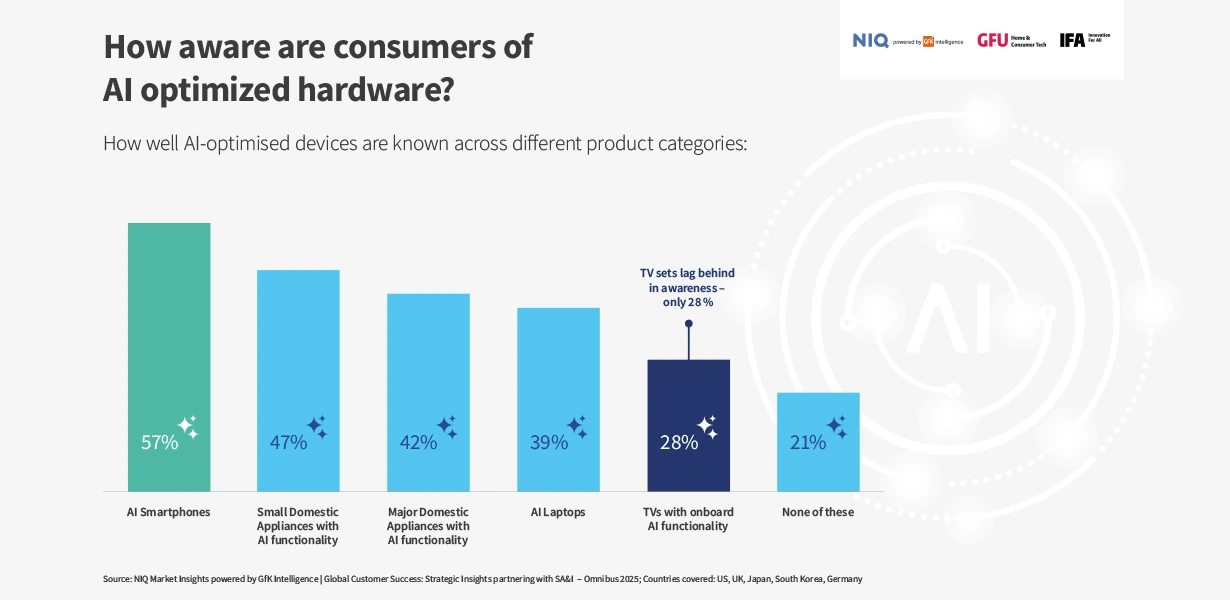
While AI software enjoys high levels of awareness, the perception of AI-optimized hardware lags significantly behind. Awareness also varies greatly between product categories. Smartphones and small household appliances in particular benefit from intensive communication by manufacturers. For example, 57 percent of consumers have already heard of AI-optimized hardware in smartphones and 47 percent in the small household appliances segment. In smartphones, AI is regularly promoted in connection with new premium models – for example through improved camera functions or personalized user experiences. In the smart home sector, meanwhile, brands build on existing scenarios: here, AI is marketed as the next level of smart control, intended to further increase convenience and efficiency.

In the laptop (39%) and television (28%) segments, by contrast, the benefits of AI-powered hardware have so far been perceived less by consumers. For many respondents, the specific advantages of AI in these categories remain difficult to grasp. While AI in smartphones, for example, ensures better photos or optimizes energy consumption in the household, laptops and TVs often lack awareness of a compelling added value, such as potential energy and product efficiencies.

Regional differences: from cautious to convinced

The study shows clear geographical differences in the perception of AI. Germany lags behind in international comparison. Only around 29 percent of consumers in Germany are familiar with AI-optimized hardware: general skepticism toward new technologies, combined with a high sensitivity to data protection, appears to be slowing openness to AI-optimized devices.

In Korea, the United Kingdom, and the USA, however, acceptance is significantly higher. Korean consumers show particularly strong interest in smart home solutions – accordingly, awareness of AI-powered household appliances is high there. In the USA and the United Kingdom, by contrast, the focus is on smartphones and small household appliances, which are often perceived as the β€œfirst AI experience platform.”

A key finding of the study: deliberate and continuous communication about the benefits of AI pays off. Where manufacturers specifically explain what concrete improvements AI brings about in their devices, consumer interest also increases. Smartphones are the best example of this – no other product benefits as strongly from the combination of technological innovation and understandable communication of benefits.

What matters to consumers

Across national borders, consumers associate AI above all with one thing: an increase in productivity. Whether at work, while learning, or in the household – AI is expected to help save time and complete tasks more efficiently.
The further development of smart home functions is also high on the wish list: many expect AI to make interaction with smart devices even more intuitive and more connected.

One topic that resonates less, however, is security. Although many manufacturers emphasize the protection of data and systems in their communications, this aspect currently has lower priority in consumers’ minds.

Ines Haaga, Director Global Strategic Insights at NIQ, summarizes her study as follows: β€œThe study makes it clear: AI has arrived in society – but in many places, understanding of AI-optimized hardware is still in its familiar infancy.” β€œManufacturers who communicate the benefits of their AI technologies clearly, understandably, and in a way that is relevant to everyday life have the best chances of winning consumers’ trust and interest. Regional differences should be taken into account in a targeted way – because what excites people in Korea does not automatically convince people in Germany,” adds Carine Chardon, Managing Director of GFU Home & Consumer Tech.

Sources

[1] KPMG and University of Melbourne Study 2025, assets.kpmg.com/content/dam/kpmgsites/xx/pdf/2025/05/trust-attitudes-and-use-of-ai-global-report.pdfΒ . Accessed online, October 2025.

Your Direct Line to GFU

Press Contact & Media Relations Manager

Whether you are requesting an interview, looking for background information, or conducting research, the GFU press team is here to support you quickly and efficiently.

Portrait von Marie-Charlotte von Heyking, Pressesprecherin von GFU
Marie-Charlotte von Heyking marie.vonheyking@gfu.de

GFU Press Distribution List β€” Stay Informed Earlier, Report Better.

As an accredited media partner, you will receive GFU press releases, studies, and image materials on Home & Consumer Tech directly in your inbox β€” concise, relevant, and ready to use.