Press Releases
Press Release: 3. September 2026
The Retail of the Future
Digitally disruptive, relevant in-store
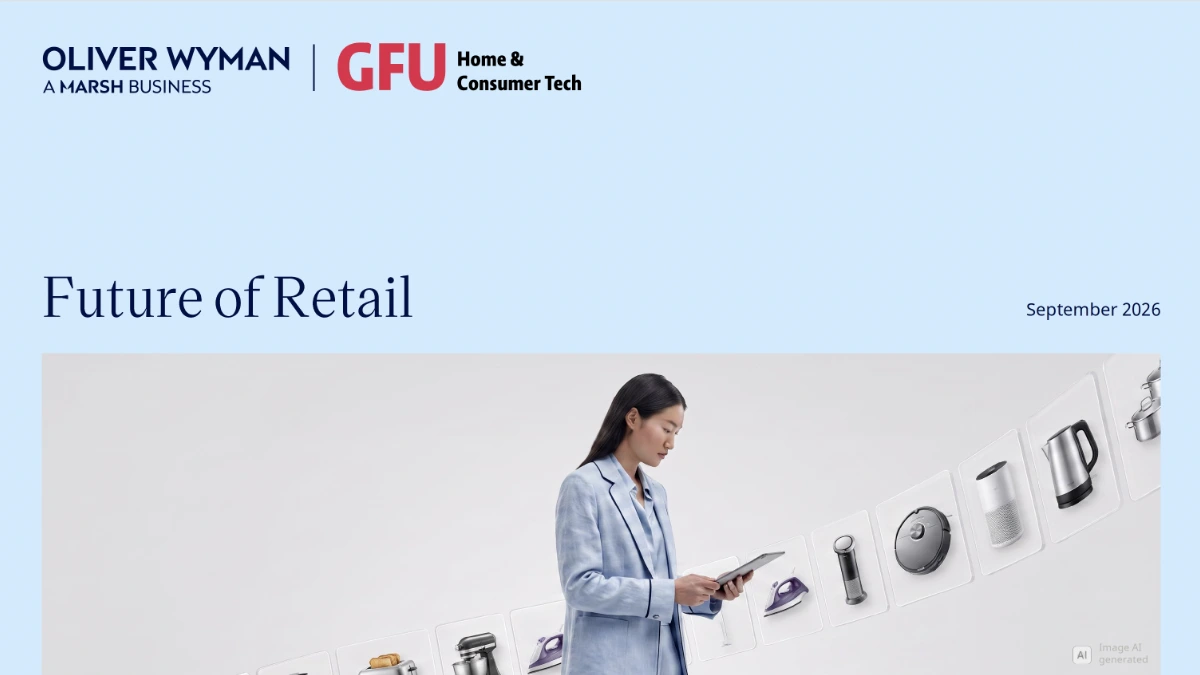
Frankfurt am Main/Munich, September 3, 2026 β What challenges arise from changing purchasing behavior in the area of electrical appliances for industry and retail? This question was explored in the consumer survey conducted by the global management consultancy Oliver Wyman, a Marsh company, and the industry organization GFU Consumer & Home Electronics. The study was carried out in August 2026 in four countries (China, Germany, the United Kingdom, and the United States). It is clear that in the future there will be no way around artificial intelligence. AI already played an active role in the most recent purchase of electronic devices for 60 percent of respondents. In China, generative technology is already involved in the purchasing process for as many as 90 percent of respondents. Consumers across all countries most frequently consulted AI to understand new device features and use cases (27%) or to incorporate user reviews and ratings (21%). While in Germany a quarter of respondents said that, thanks to AI, they discovered a product they had not previously known about, 37 percent of respondents from China had a product recommended specifically for their needs and budget.
Openness to AI in the purchasing process is already high today
Across countries, 82 percent of respondents can generally imagine using AI as a source for product search and information, and more than one in two (53%) would allow AI to make a preselection of products. Slightly more than one third (35%) would be willing to leave the final product recommendation to AI β but most still want to make the final choice themselves, and only four percent would currently allow an AI agent to shop autonomously on their behalf. Respondents in the United States are significantly more open to this (6%) than those in the other nations (China: 1%). Attitudes in Germany are overall below average.
The importance of AI in the purchasing process is likely to continue to rise, as trust in AI when shopping is growing: nearly one third of respondents (32%) expect LLMs and AI agents to be their most important sources of product advice within three to five years. In China, the figure is already as high as 44 percent. In addition to the consumer study with 4,000 participants, qualitative interviews were conducted with some of the most internationally relevant companies from industry and retail. In this context, the executives surveyed expected transaction-capable AI agents to change market mechanisms within two to three years to a degree similar to the rise of Google around the turn of the millennium. This creates a new discipline for retailers and manufacturers: in the future, marketing will have to convince not only people, but also machines. Retailers or providers that are not visible in AI systems risk no longer being considered in product selection in the future.
New sales channels: Social commerce is gaining importance
AI is not the only factor playing an increasing role in product discoverability and the purchasing process. Social commerce is also establishing itself as another sales channel alongside brick-and-mortar stores and traditional online retail: Overall, 41 percent of all respondents have already made purchases via social commerce. Seventeen percent of respondents have already purchased small electrical appliances via social commerce; for large appliances, the figure is half as high. In China, social commerce is already much more widespread, at more than two thirds (70%). Almost one in five (18%) has already purchased large electronic devices such as televisions via social platforms, and more than one third (36%) have shopped for small electrical appliances. In Germany, the figures so far are still below ten percent (large appliances) and five percent (small appliances), respectively. Interestingly, a total of eight percent of respondents say they have made an impulse purchase via social commerce. Across countries, 23 percent of study participants expect to make purchases via social platforms in three to five years; in China, the figure is as high as 48 percent. Social networks are thus evolving from purely inspirational channels into relevant sales channels, including for larger purchases.
βWhat can I do for you?β: Opportunities for brick-and-mortar retail
Brick-and-mortar retail in particular will continue to be able to hold its own against new sales channels such as social commerce if it focuses more strongly on its core competencies: advice, product experience, and service. Most recently, brick-and-mortar retail played a role in the purchasing process for three quarters of respondents across all countries. Thirty-two percent of purchases are still made in stores. And on site, what matters most is the direct experience of products, the ability to touch and try them out (55%), as well as personal advice (40%). When it comes to βservice,β customer support is more important than delivery speed. Same-day delivery is decisive for purchase for only 22 percent, while warranty and after-sales services such as repair service are decisive for 39 percent. Especially for larger investments, more than a quarter of respondents across all countries plan to visit brick-and-mortar retailers even in three to five years, while 24 percent will in the future give preference to retailers that make sustainability measures easier. The future of brick-and-mortar retail therefore lies above all in its core competencies.
Carine Chardon Managing Director of the industry organization GFU Consumer & Home Electronics
βConsumers in Germany still lag significantly behind those in the United States, the United Kingdom, or China when it comes to acceptance of AI and social commerce. Low-cost platforms from the Far East are also less accepted in Germany. Nearly 40 percent of respondents have never made purchases via such platforms and would not do so. Looking to the future, we expect that in Germany, brick-and-mortar retail in the premium segment is most likely to retain an important place. Here, quality, service, and trust remain decisive for brand loyalty.β
Martin Schulte Partner and Global Head of Consumer Durables, Oliver Wyman
βAI is climbing the ladder of consumer trust step by step; the purchase button is the last thing they hand over. Manufacturers should get their product data in order now, otherwise AI systems simply will not find them. For retailers in the premium segment, the opportunities lie above all in advice, installation, repair, and other services.β
About the study
For the βFuture of Retailβ study, around 4,000 people in Germany, the United Kingdom, the United States, and China were surveyed representatively in August 2026 (including 1,000 people in Germany). In addition, executives from manufacturers in the consumer electronics and home appliance industries as well as leading retail companies were interviewed. Oliver Wyman cooperated with GFU Consumer & Home Electronics, the brand owner and umbrella organization of IFA, one of the worldβs leading trade fairs for home and consumer tech, for the survey. The full study results will be presented at IFA 2026 in Berlin.
About Oliver Wyman
Oliver Wyman is a Marsh company (NYSE: MRSH), a global leader in risk management, reinsurance and capital, human resources and investment management, and strategy consulting services. With clients in 130 countries, annual revenue of more than US$27 billion, and more than 95,000 colleagues, Marsh brings together diverse perspectives and supports clients in achieving their goals. For more information, visit us at oliverwyman.de or follow us on LinkedIn and X.