
Press Releases
Press Releases: 13. February 2026
World Radio Day 2026
A Medium Reinvents Itself Again and Again
02/12/2026 – Frankfurt am Main
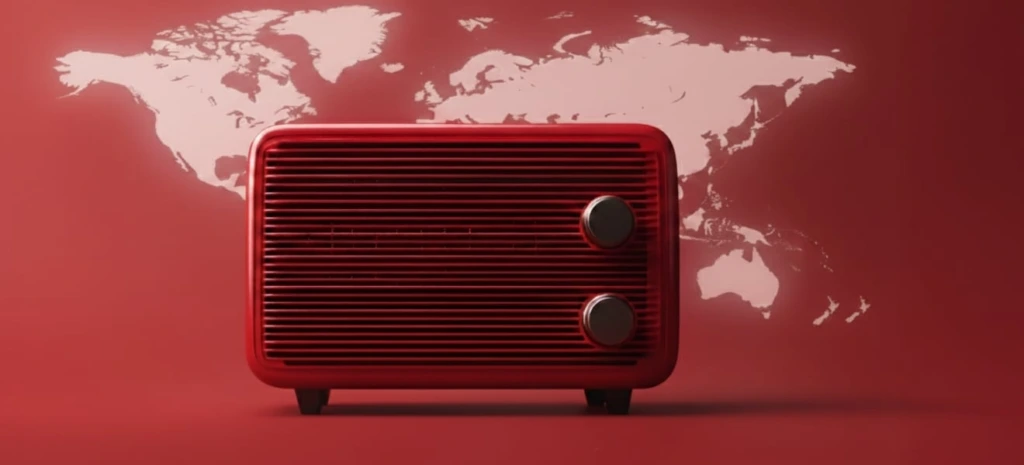
On February 13, World Radio Day is celebrated around the globe – an occasion to look at a medium that has entertained, informed, and accompanied people for more than a century. What once began with the first wireless sound experiments is still today a highly modern, digital mass medium with great social relevance.
The origins of radio date back to the early 20th century. Naming a single person as its “inventor” is hardly possible: too many technical breakthroughs and brilliant minds contributed to its development. A milestone is considered to be the Christmas broadcast by Canadian engineer Reginald Fessenden in 1906. For the first time, he transmitted speech and music by radio – with gramophone music, a live violin piece, and spoken word. This broadcast, which was received as far away as the Caribbean, marked the beginning of radio as an entertainment and information medium.[1]
In the decades that followed, radio broadcasting developed with great dynamism worldwide. As early as the 1920s, regular radio programs emerged – for example in the USA with the founding of the first nationwide radio network, NBC, in 1926, or in Europe with early broadcasting stations such as the Eiffel Tower in Paris and the Berlin Radio Tower. The latter was built in 1926 on the occasion of the 3rd Radio Exhibition and marks the dawn of broadcasting in Germany. The IFA itself made the social significance of the new medium visible with its very first exhibition. Accordingly, radio also quickly developed in Germany into one of the first electronic mass media: low-threshold, wide-reaching, and usable regardless of education or social status.
These characteristics continue to define radio to this day. It is immediate, reliable, and close to people’s everyday lives. At the same time, radio was and remains a technological driver: without broadcasting technology, developments such as television, aeronautical radio, maritime radio, or modern radio navigation would hardly have been conceivable.
From the FM era to the digital future
With the introduction of DAB+ from 2007 onward, the digitalization of radio broadcasting entered a new phase. Digital radio offers more programs, more stable reception, additional data services, and significantly more efficient use of frequencies. The DAB+ network has been greatly expanded in recent years and reached over 91% of the population by the end of 2025. Analog FM broadcasting is already being gradually scaled back, with a complete replacement by DAB+ under discussion for 2027. [2][3]
Acceptance of the new transmission method is growing among listeners: according to current audio market data, around 40 percent of German households now have at least one DAB+-enabled device – with a sharply rising trend. This is particularly true in cars, where DAB+ receivers are also required by law, but also in the home.[4]
Radio remains – just different
For people, radio remains an indispensable medium: it provides reliable information, offers guidance, promotes cultural diversity, and reaches people even in crisis situations. The fact that technology and distribution channels are changing is not a rupture, but part of its history. Podcasts also fit into this development – as a time-independent, digital extension of radio broadcasting that enables modern forms of storytelling and brings radio to where people also listen today: on the move, individually, and on demand.
“Radio is one of the most adaptable media of all,” says Carine Chardon, Managing Director of GFU Consumer & Home Electronics GmbH. “From the first radio signals to digital broadcasting, it has reinvented itself time and again. Digital radio stands for this ongoing development: for quality, diversity, and future viability – and for ensuring that radio will continue to play a central role in the media mix in the decades to come.”
Sources
[1] http://www.deutschlandfunk.de/100-jahre-radio-100.html
[2] https://www.teltarif.de/radio-dabplus-ukw-ard-privatfunk-abschaltung/news/101659.html
[3] https://www.teltarif.de/radio-ukw-dab-digitalradio-abschaltung/news/101638.html
[4] https://www.die-medienanstalten.de/forschung/audio-trends-2025/