Press Releases

GFU Study: 22. January 2026

AI-based chatbots are increasingly shaping communication and everyday life for people in Germany

Frankfurt am Main, 01/22/2026

Artificial intelligence has become part of everyday life for many people. This is demonstrated by a recent survey study by GFU Consumer & Home Electronics GmbH, conducted by YouGov on its behalf among 2,002 participants. According to the study, consumers in Germany are already frequently using AI-based chatbots today – for gathering information, finding guidance, and receiving support in a wide range of areas of life.

High acceptance and regular use

69 percent of respondents say they already use AI chatbots, usually even several times a week; more than one in four even use them daily. Usage is particularly pronounced among younger age groups aged 18–34, where the use of AI assistants is established almost across the board. In addition, men and people with higher household incomes show above-average interest and strong penetration in the use of AI-based assistance systems.

Purposes of use, areas of life, and typical application situations

The survey shows that AI models have so far been used primarily in leisure and everyday contexts. For more than two thirds of respondents who use AI regularly, information search is by far the most important use case (around 69% of all users). Older people (55 years and older) particularly value AI as a source of knowledge (76%), while younger respondents prefer to use AI to write, revise, or creatively generate texts (45%). In addition, AI models are increasingly being used for creative tasks such as image, video, or audio generation (up to 23%, depending on age group) as well as for data analysis, calculations, and programming (between 8% and 15%, depending on age). AI assistants are currently still used comparatively little for product research or purchase advice (one quarter of respondents). Overall, it can be concluded that AI assistance systems are accepted and used as a supportive tool in almost all areas of life – from entertainment and education to professional activities.

Are AI-based digital assistants competing with established systems?

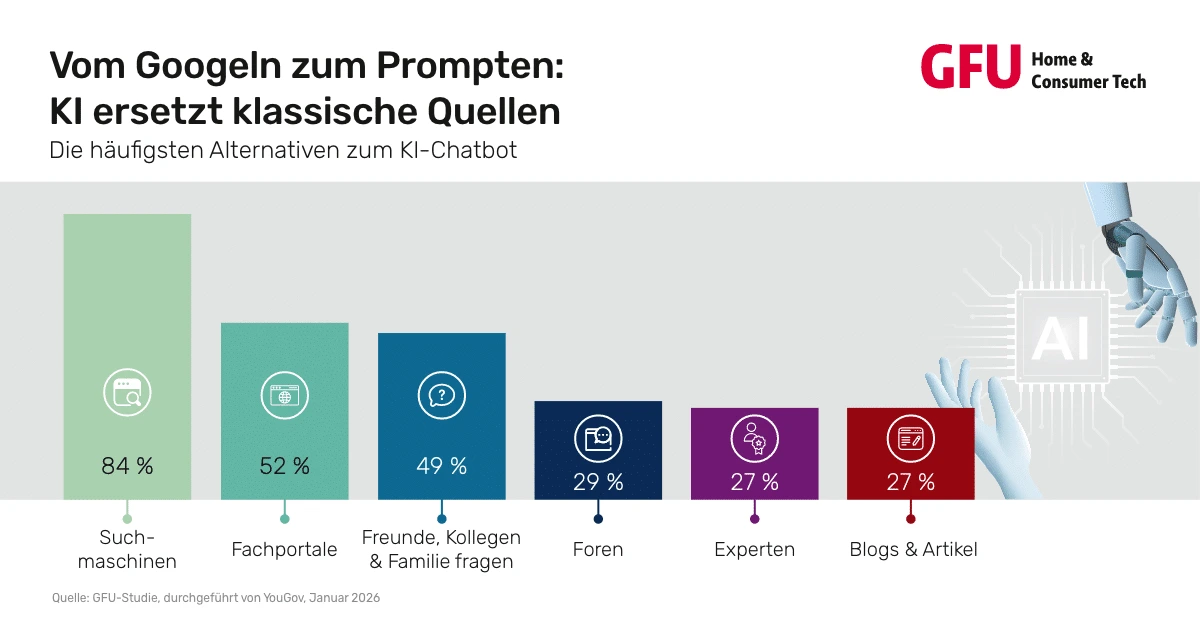
If AI models were not available, respondents would primarily turn to traditional search engines (between 74% and 89%, depending on age group). This makes search engines the largest source of substitution for AI-based digital assistants among respondents. Or, put another way, AI is therefore replacing traditional information gathering via search engines. Specialist portals (52%), friends/colleagues (49%), forums (29%), and experts (27%) are also being replaced as sources of knowledge and interaction platforms by common AI models. Overall, the study illustrates that AI models are already taking over numerous routine tasks and thereby maximizing the efficiency of traditional research and processing workflows.

Pragmatic and reflective attitude toward existing AI models

Overall, attitudes toward generative AI models can be described as pragmatic but considered. Users primarily regard the technology as helpful and time-saving, yet according to their own statements, they still often additionally verify the information received using various sources. While AI responses are generally perceived as reliable, trust is lower when it comes to more complex topics.

Tomorrow we will know what happened today

The results of the survey study underscore that AI-based chatbots have developed in a very short time from a technological innovation into a natural digital tool. They complement existing information and work processes, accelerate routines, and open up new forms of interaction – both privately and professionally. What will be crucial for further development is how consistently it will be possible to further improve the usefulness, quality, and reliability of these systems and adapt them to users’ differing expectations.

Carine Chardon, Managing Director of GFU Consumer & Home Electronics GmbH, puts the results into context: β€œThe study shows that AI-based applications are already firmly embedded in many people’s everyday lives. In addition, it becomes clear that consumers use the technology very consciously – as an efficient tool, not as a substitute for their own judgment. This is precisely where the innovation potential lies: AI supports, structures, and inspires – and thus becomes an integral part of a modern, connected everyday and working world.”

In a second part of the GFU study, conducted in January 2026, the role played by AI-based language models in purchasing behavior in the technology sector was examined. GFU is expected to publish the results of this analysis at the end of February 2026.

Your Direct Line to GFU

Press Contact & Media Relations Manager

Whether you are requesting an interview, looking for background information, or conducting research, the GFU press team is here to support you quickly and efficiently.

Portrait von Marie-Charlotte von Heyking, Pressesprecherin von GFU
Marie-Charlotte von Heyking marie.vonheyking@gfu.de

GFU Press Distribution List β€” Stay Informed Earlier, Report Better.

As an accredited media partner, you will receive GFU press releases, studies, and image materials on Home & Consumer Tech directly in your inbox β€” concise, relevant, and ready to use.