
Insights & Trends Forecast 2026
The trend topics in detail
The key trends at a glance: Jump straight to the topic that interests you.
From Gadget to Companion
How Ambient Tech and Embodied AI Continue to ease Everyday Life
Beyond the market forecasts based on numbers, a highly intriguing transformation is taking shape at the intersection of technology, design, and society. The following section highlights the defining trends that extend far beyond short-term product cycles and will have a massive impact on our daily lives in the future.
The era of technological superlatives is far from over, but its nature is changing. One of the reasons is a fundamental shift in consumer needs: In a society characterized by an aging population, a significant shortage of skilled labor in the service sector, and high levels of mental stress in both professional and personal lives, consumers are seeking palpable relief. More and more, technology is taking a back seat and acts as an invisible, intuitive helper – a development that is ushering in a new era in the use of household appliances.
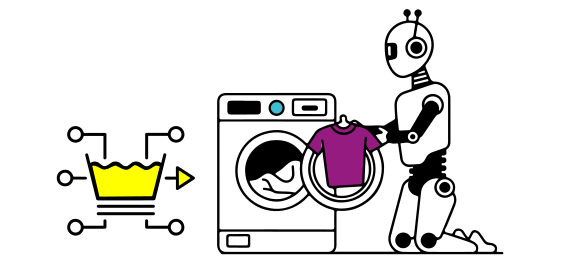
The Proactive Household Manager
Freedom from the “Mental Load”
Modern housework in the Western world is characterized by mental self-organization. “Mental load” – the invisible mental work involved in managing a household – has long become a socially established catchphrase. This is precisely where the next generation of consumer electronics and home appliances comes in: the shift from a passive tool to a proactive partner in decision-making.
Next-gen devices no longer wait for commands but anticipate their users’ needs instead. Smart home appliances are increasingly making use of local sensors and machine learning to optimize workflows autonomously. For example, they analyze the composition of textile fibers or the degree of browning in baked goods, meter resources with great precision, and independently fine-tune washing or cooking processes to perfection. Taking dynamic electricity rates into account, they start wash cycles exactly when power is cheapest and least polluting. Technology thus takes on part of the cognitive burden of household planning and acts as a silent, efficient manager in the background.

Ambient Intelligence
When Technology Blends with Home Life
From the small kitchenette in a student apartment to a stylish outdoor kitchen in your own backyard, new design concepts are more in demand than ever. The trend points toward a seamless aesthetic in which technology is only visible when it is actively needed.
This concept of “ambient intelligence” is impressively demonstrated, for example, in visionary TV designs such as transparent OLED screens, which, in off mode, resemble an elegant pane of glass or an aquarium and only transform into a brilliant display when in use. In the kitchen, entire cooking processes disappear into drawers and magically produce perfectly cooked meals.
Haptic controls are also undergoing a radical transformation: control panels substitute natural materials for flashing displays. Sensory surfaces made of wood, fabric, or stone respond to gentle touches, making the control of heat, light, music, or room temperature an organic part of home design. Technology is literally fading out of eyesight and adapts to the Scandinavian minimalist style of living that dominates many German households.
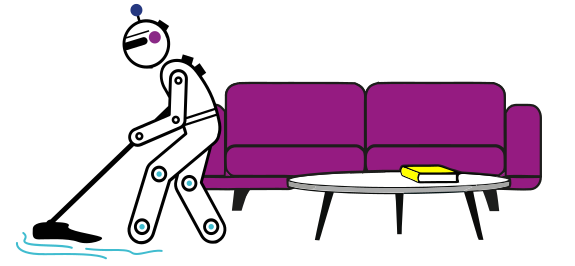
Embodied AI
Physical Assistants Are Moving In
We are taking great strides toward “embodied AI”: artificial intelligence that possesses a physical body and actively moves through space. In a country where more and more people live in single-person households and professional care and household help are difficult to afford or simply not available, this trend is evolving from a sci-fi scenario into a social necessity.
Androids, originally developed for industrial use, are currently undergoing rapid learning curves. By the end of the decade, these systems will be capable of performing complex physical tasks around the home – from loading the dishwasher and sorting laundry to assisting people with limited mobility in their daily lives.

The Post-Smartphone Quandary
What’s the Next All-Rounder Device?
As a universal “one-device solution,” smartphones have revolutionized our lives, but their form factor is reaching its limits. The industry is actively searching for the next revolutionary everyday companion.
AI-powered wearables are currently generating a lot of buzz – smart rings and smart eyeglasses are experiencing a real boom right now. Thanks to integrated multimodal AI, these glasses scan the user’s surroundings, translate foreign-language street signs in real time directly into the user’s ear, or project navigation instructions into the user’s field of vision. The display is shifting from our hand directly into our line of sight: The smartphone is gradually deconstructed and spread across minimalistic wearable accessories. At the same time, society is facing new challenges in this area, such as privacy and the right to one’s own image.
Pet Tech
When AI Becomes an Animal’s Best Friend
There are approximately 34 million pets living in Germany*. In millions of households, dogs or cats have taken the place of a partner or child and are full-fledged family members. At the same time, the demands of a working life require a great deal of flexibility, often presenting pet owners with logistical and emotional challenges. This has triggered an unprecedented boom in “pet tech” in this country, an industry sector that has long been booming in the Far East, for example. Smart automatic feeders now use “face” recognition to prevent food jealousy and malnutrition in multi-cat households. Wearables for pets, such as smart collars with built-in AI health monitoring, analyze the animal’s sleeping and scratching behavior to detect heart disease or pain early on, before clinical symptoms become apparent. Even interactive toys use algorithms to adapt to the pet’s activity level and mitigate loneliness while the owners are away. Pet tech exemplifies how technology bridges emotional gaps and creates genuine, measurable added value for the coexistence of humans and animals in today’s urban environments.
The Age of Empathic Technology
Whether it’s proactive household management, seamless design integration, physically active robotics, body-worn devices, or smart care for our pets – all these developments illustrate that we have reached the end of the era in which we use technology merely as a tool. In the coming decade, technology will no longer be perceived as alien objects that we must laboriously learn to operate, but rather as an empathetic, forward-thinking companion that blends seamlessly into our lives. Manufacturers who master this symbiosis of technological utility and human quality of life will help shape the markets of the future.

More from the Insights & Trends Forecast